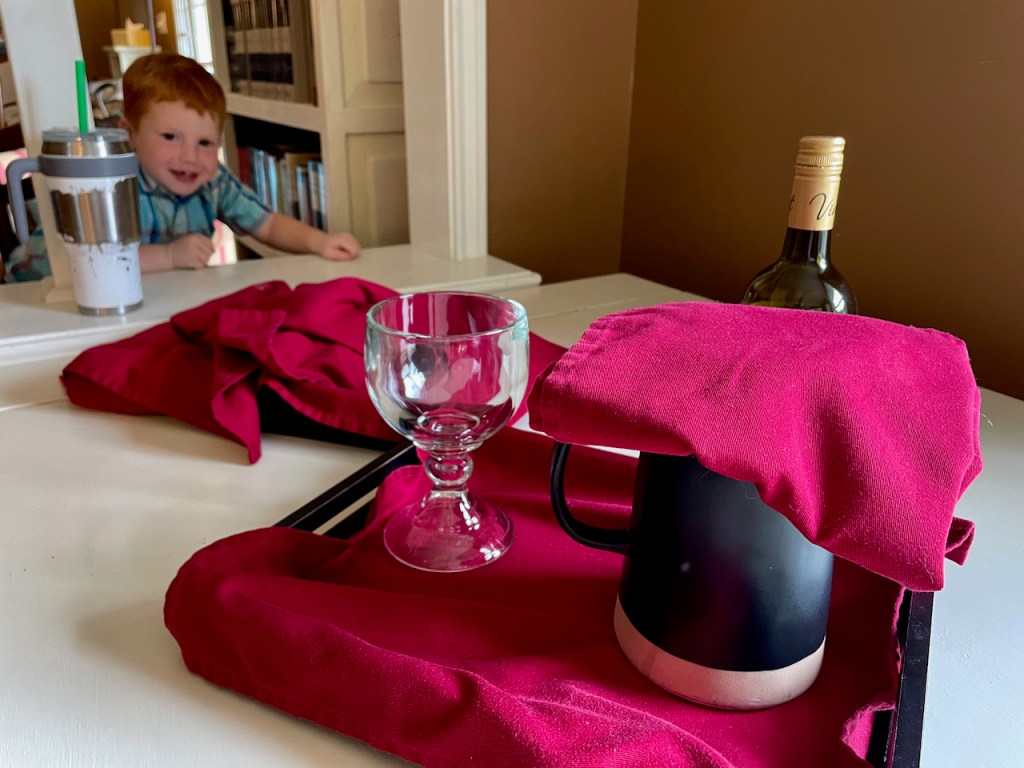
A fellow pastor from my previous denomination posted this on his Facebook page: “Paedocommunionsists practice a form of baptismal regeneration.” He was taking a dig at those of us who joyfully practice paedocommunion. I’m sure most people are thinking: “paedo-what???”
What is paedocommunion?
It is the belief and practice of allowing our children to partake in the LORD’s Supper, also known as communion. We do this because they are already members of the church through the sacrament of baptism, which is, paedobaptism.
In paedobaptism, we completely agree with our Reformed Brethren. We believe that children should be given the sign of the covenant, shortly after they are born. This isn’t because we believe in baptismal regeneration, but because they are a part of the covenant, and need the sign of that covenant. We don’t know if the child is spiritually regenerate at baptism. We know they could be, just like John the Baptist was regenerate inside the womb of his mother Elizabeth, but there is no way of knowing.
Our argument is that all the reasons we hold to paedobaptism are the same reasons we should hold to paedocommunion. Most Reformed Presbyterians disagree.
Now, the rift between us and our Reformed brethren is over the admonition in 1 Corinthians 11, that a man should examine himself:
27 Therefore whoever eats this bread or drinks this cup of the Lord in an unworthy manner will be guilty of the body and blood of the Lord. 28 But let a man examine himself, and so let him eat of the bread and drink of the cup.
Paul was addressing two sins that were occurring among the Corinthians. The first sin was sectarianism, which was reflected in the fact that when they partook of communion, they were not waiting for one another, and leaving the poor out of communion. The second reason was that they were getting drunk and abusing the table. Both sins were missing the entire point of communion, and leading to the death of some of the Corinthians (1 Corinthians 11:30).
This sickness that was taking place, wasn’t brought on by the elders of the church, but by the Holy Spirit. This is important to notice because far too many elders think they have the responsibility to fence the table. The LORD is quite capable of fencing His own table. The Holy Spirit was fencing the table in Corinth, not the elders.
Fencing the Table
In our arrogance, we have come to the belief that it is our responsibility to fence the table. What hubris.
For those who don’t know, fencing the table is the part of the service where the pastor will say something along the lines of, “all are invited to partake, who have been baptized, and are members of an evangelical church in good standing, and are not in any gross or heinous sins.”
This is the idea of a men examining themselves. But there are a lot of problems with this concept. For one, when Jesus gave us the Lord’s Supper, Judas Iscariot was right there in the mix. Judas, who was involved in a gross and heinous sin of betraying Christ to the the Jewish authorities, was served communion by the LORD Himself. Jesus said nothing to Judas that would indicate that we are to “fence the table.” Jesus didn’t fence Judas from the table.
Another huge problem with fencing the table in such a way, is that you are setting up the table, which is a table of grace, and making the table a place of works. In other words, one has to perform certain works in order to approach the table. He or she (and notice that the admonition in 1 Corinthians is not to the women, but to the men, in the singular), who wishes to partake of the table, must do so by works righteousness, not grace.
Baptism? Check.
Church membership? Check.
Good standing? Check.
No heinous sins? I got this! Check!
This is one of the very reasons I believe the Reformed church is so weak and deficient in bearing fruit. Those who practice fencing the table, are actually practicing works righteousness. They are setting up standards for which the believer must meet in order to come to the table.
I do believe that those who come to the table should be baptized. However, if I have someone in my worship service who desires to partake of the supper, who is not baptized, I would let them. If they hunger for the supper, let them eat. Christ did. He fed the 5,000 because they hungered. The same grace should be shown at the table.
This doesn’t mean that the person partaking should not get baptized. But we must recognize that babes often have food before they are washed.
Excommunication
The other problem I have with the way that my Reformed brethren fence the table, and this is the biggie, is that they are excommunicating members of the body from the table. When a church denies a child, who has been baptized, and given the sign of the covenant, from they table, they are in effect, excommunicating the child from the LORD’s supper. They are telling the child that they are not worthy to eat the bread and drink the wine that the LORD has given to His people.
On what grounds? They say this is because a child cannot examine himself, as is prescribed in 1 Corinthians 11. Yet, that text wasn’t written to to the children, or the women. It was written to the men. Have the men been divisive? Have they become drunkards at the table? Were they excluding people who were poor, and taking communion before them, leaving the poor to fend for themselves? If any of these things were true, then the men were not to partake.
The verse said nothing to the women. It said nothing to the children. The women, and the children, were not guilty of those sins, just the men. And if the men were not guilty, then they were to partake. But if they were guilty, then they should abstain.
The dirty little secret is that those men in Reformed circles who are excluding the children, the poorest of all, are guilty of the sin Paul is writing against. So the very verse they use to qualify someone for the table, is the very verse that disqualifies them from the table. They are guilty of sectarianism, of dividing the body.
Conclusion
The major point in all this is being faithful to God’s calling in the church. He has called us to be a body, the Body of Christ, and nothing symbolizes this more than the LORD’s supper. Given His passion for children, for the weak, and for the poor, it just makes no sense that the Table of the LORD should ever be divided by the haves, and the have nots. In the Reformed camps, this has fallen into those who have correct theology, and those who don’t. Yet, Christ desires to feed the have nots. So to restrict them from the Table, is the very sin that Paul was writing against in 1 Corinthians 11. This is why we insist, that our children partake.
No, they don’t understand. But with the feeding of God’s grace, we are trusting that the Spirit will work in their lives, and they will, one day, understand the rich grace they have been given in the simple bread and the wine.




 That... Which Matters Most
Leave a comment